In-your-face woman Jeanette Rankin apparently had it in her to serve the State of Montana and her country in the United States Congress. Unfortunately, she couldn't get there without women securing the right to vote. So she started her campaign, as it were, by working for women's suffrage five years before Montana allowed its female citizens to vote in 1914 and seven years before Rankin herself went to Washington.
Committed to women's rights, the rights of the poor (with whom she had worked in the Lower East Side of New York City), and the establishment of a participatory democracy welcoming input from all citizens, Rankin was a woman of the people and, as such, was so popular that she was elected in 1916 and again in 1940.
Unfortunately for Rankin's political career, her vote against sending the U.S. into World War I cost her much support because, even though forty-nine other Congressional Representatives voted against joining the war effort, as well, Rankin, as the only woman in Congress, was already hanging by a thread. Consequently, her first term ended the year before the 19th Amendment to the U.S. Constitution was finally enacted, giving women the right to vote.
Rankin, however, stayed busy. She lobbied to promote maternal and child health care. She moved into a one-room cabin without electricity in Georgia and began the Georgia Peace Society (which many Georgians called treasonous, accusing her of being a Communist). And she went back to Congress in 1940 and again voted against entering a world war (the only member of Congress to do so). "As a woman, I can't go to war," she told her fellow Congressional Representatives, "and I refuse to send anyone else."
Needless to say, she was sent packing the next election day, so she retired from electoral politics, but when the Vietnam War reared its ugly head nearly thirty years later, Rankin -- now 88-years-old -- organized and sent thousands of young protesters to Washington, D.C., calling themselves the Jeanette Rankin Brigade. In-your-face women stand for something and will, when necessary, stand alone.
because the woman's place is wherever the woman is...
Tuesday, July 31, 2012
Monday, July 30, 2012
Sally Rand
It's hard to imagine what Hattie Beck's Army colonel father and school teacher mother must have thought of her becoming a chorus girl in Missouri at thirteen years of age in 1917, but they either didn't -- or couldn't -- stop her. Proceeding to work her way to Hollywood, Beck's in-your-face ambition (and long shapely legs, we can assume) soon got her noticed by Cecil B. DeMille, who put her in a few silent movies after changing her name to Sally Rand.
When the talkies came on the scene, any actor with a voice that didn't satisfy producers' criteria was pushed out or switched over in some way. So Rand became a dancer, but not just any kind of dancer. Rand became an in-your-face, over the top, looks-like-she's-naked dancer. And was promptly arrested four times in one day at the Chicago World Fair for riding down Chicago streets on horseback dressed only in feathers. In fact, from then on, she was routinely and often arrested for appearing to be naked.
It wasn't that people didn't know she wasn't naked. Au contraire! One judge, for example, even gave her immunity in advance in case she was arrested again for indecent exposure while she was out on bail after the current indecent exposure arrest. People (including judges, apparently) loved Rand's fan dancing. And Rand was getting so much attention -- and making so much money -- there was no way she was going to modify her costumes or her techniques.
It ultimately became so much fun for everybody that Rand was even arrested once wearing long underwear and a "censored by the SFPD" sign -- despite the judge's immunity ruling. "I haven't been out of work," Rand told reporters, "since the day I took my pants off!" Was that just an observation? Or was that an in-your-face woman's advice to the rest of us?
Sunday, July 29, 2012
Alice Huyler Ramsey
Nine months after the first Model T Ford rolled off the assembly line, while women were still being told that driving cars would be too much for them, Alice Huyler Ramsey, a 22-year-old wife and mother from Hackensack, New Jersey, loaded up three other women in a green Maxwell 30 and set out to drive across the United States. Fifty-nine days and 3,800 miles later (only 152 of which had been paved), Ramsey cruised into San Francisco to tell the tale to crowds of delighted well-wishers.
On the journey, Ramsey (who was the only driver in the car) changed eleven tires, cleaned the spark plugs, and repaired a broken brake pedal. And those weren't the only inconveniences. There was a killer loose in Nebraska, bedbugs in Wyoming, angry Native Americans in Nevada, and at least one night when they had to sleep in the car because it got stuck in the mud. But Ramsey -- in true in-your-face woman fashion -- not only didn't crack, she made the trip more than thirty times from 1909 to 1975 (when she was 89!). Interviewed by Ms Magazine after her last trip, Ramsey said simply, "Good driving has nothing to do with sex. It's all above the collar." Duh!
Saturday, July 28, 2012
Harriet Quimby
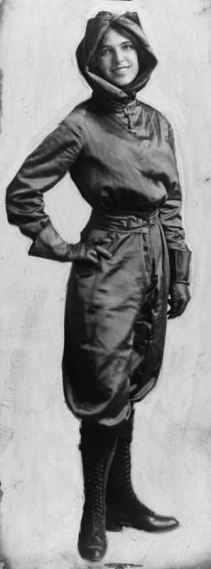
Far from being the tough type, Quimby was, in fact, a farm girl who became a photo-journalist and a screenwriter in the very early 1900's. But then she discovered flying. “If a woman wants to fly," she declared, "first of all, she must, of course, abandon skirts."
Taking planes into the wild blue yonder in the purple satin hooded jumpsuit she designed herself, she became such an overnight sensation that she was offered $100,000 to present a flying exhibition to an obviously large and well-paying crowd near Boston, Massachusetts, on July 1, 1912.
Buzzing around 1500 feet in the air in a brand new open cockpit two-seater Bleriot monoplane, Quimby and her passenger (the guy who had organized the event) were having a swell time thrilling the folks below when an air pocket caused the plane to lurch, ejecting them out of their seats and they fell to their deaths in front of their horrified viewers.
Quimby was thirty-seven. She wasn't married. She had no kids. She was supporting her parents. And she didn't even leave a diary. Oh, those in-your-face women! They can be a carefree and mysterious bunch, huh?
Friday, July 27, 2012
Anna Henryka Pustowojtowna
Taking the name Michal Smok, she fought valiantly under insurrectionist Marian Langiwicz. She was so valiant, in fact, that she was reported to have ridden into a hail of bullets in one battle, striking those who cowered with the flat of her broadsword and shouting, "Shame on you! Forward! Win or die!" Captured by the Austrians (along with Langiwicz), Pustowojtowna tried several times after her release to break her leader out of jail, but was ultimately forced to face the fact that she wasn't going to live long if she tried to stay in Poland.
So she went to Paris where she spent the rest of her life selling artificial flowers, teaching music, and raising children (her own and other people's). Oh, yes...and also fighting on the barricades to establish the Paris Commune of 1871. Sometimes, the in-your-faced-ness is part of a situation in which an ordinary woman finds herself. Sometimes, on the other hand, the in-your-faced-ness is part of the woman.
Thursday, July 26, 2012
Eleonore Prochaska
Not only have women fought in every war waged throughout history, but their stories have been a matter of public record. Ludwig van Beethoven wrote music for a play about Eleonore Prochaska, for example, and a memorial to the woman sometimes called the Potsdam Joan of Arc was erected in Potsdam in 1889, yet her name is hardly a household word.
Prochaska was born in 1785 to a poor Prussian army officer who sent her to an orphanage when her mother died. Like many European girl children set adrift, she was trained for domestic service, but something in her in-your-face woman's soul wouldn't let her settle for that. So she enlisted in the forces fighting against Napoleon, put on a uniform, and marched to war where she served first as a drummer and then as a regular foot soldier. Signing a letter August Renz, Private Voluntary with the Lutzow Freicorp, Prochaska wrote her brother that she was "convinced from the depth of my soul not to be committing any evil or light-headed deed...just consider how girls and women in Spain and Tirol have behaved [in fighting against Napoleon]...!"
A relatively short time later, she was wounded in battle and uttered her last recorded words, "Lieutenant, Sir. I am a girl." Unfortunately, she died of her wounds three weeks later after what was described as "unspeakable suffering," so we'll never know what would have happened next.
But the bottom line is that women have always and often demonstrated the same passions, courage and determination of men, despite the fact that they have been forced by patriarchal power structures to hide who they really are while they're doing it. It was no mistake, however, that Eleonore Prochaska's last words put her on the historical map not as just one more fallen soldier, but as an in-your-face woman.
Prochaska was born in 1785 to a poor Prussian army officer who sent her to an orphanage when her mother died. Like many European girl children set adrift, she was trained for domestic service, but something in her in-your-face woman's soul wouldn't let her settle for that. So she enlisted in the forces fighting against Napoleon, put on a uniform, and marched to war where she served first as a drummer and then as a regular foot soldier. Signing a letter August Renz, Private Voluntary with the Lutzow Freicorp, Prochaska wrote her brother that she was "convinced from the depth of my soul not to be committing any evil or light-headed deed...just consider how girls and women in Spain and Tirol have behaved [in fighting against Napoleon]...!"
A relatively short time later, she was wounded in battle and uttered her last recorded words, "Lieutenant, Sir. I am a girl." Unfortunately, she died of her wounds three weeks later after what was described as "unspeakable suffering," so we'll never know what would have happened next.
But the bottom line is that women have always and often demonstrated the same passions, courage and determination of men, despite the fact that they have been forced by patriarchal power structures to hide who they really are while they're doing it. It was no mistake, however, that Eleonore Prochaska's last words put her on the historical map not as just one more fallen soldier, but as an in-your-face woman.
Wednesday, July 25, 2012
Mary Ellen Pleasant
She claimed to be the daughter of a Virginia governor's son and a vodou priestess slave, for example. In any case, she appeared as a servant in a household on Nantucket in the 1820's, a wealthy household that was not only a stop on the Underground Railroad, but a place where well-known abolitionists showed up on a regular basis, as well.
Supported by her employers, Pleasant, passing for White, was soon deeply involved in Underground Railroad activities, which she carried out for many years in the North, in New Orleans (where she spent much time with the famous vodou practitioner Marie LaVeau) and in San Francisco, where she lived for the last decades of her life.
Pleasant married money on two occasions and learned how to make plenty of it herself, as well, by running exclusive restaurants where bankers and stockbrokers lunched and openly discussed their business matters. Consequently, by 1875, she shared a thirty million dollar fortune with her lover du jour, which she used to bankroll abolitionist endeavors. In fact, when John Brown was arrested while trying to rob the armory at Harper's Ferry, Virginia, he had a note in his pocket from Pleasant and it was only because the authorities failed to read the initials on the signature correctly that she escaped arrest and execution herself.
Pleasant's successful forays into anti-discrimination legal battles got her named the "mother of the civil rights movement" in California and her home designated in certain circles as the "Black City Hall." Nevertheless, while she never made any bones about being Black in the Black community, she shocked more than a few White folks when she modified her listing in the San Francisco City Directory to read "Black" instead of "White" after the Civil War. In-your-face women play by their own rules and don't care much how other people feel about that.
Tuesday, July 24, 2012
Countess Emilia Plater
Poland, Lithuania, and Belarus all celebrate the legacy of the revolutionary Countess Emilia Plater who died young but has not been forgotten. Well educated as a child, her first heroes were women warriors Joan of Arc and Laskerina Boubalina (see the list of in-your-face women to your right), which would certainly indicate her commitment to in-your-facedness early on, especially since she bolstered her scholarly endeavors with training in how to ride horseback and shoot a gun.
When the Baltic States rose up against Imperial Russia in 1829, Plater cut off her hair, put on a uniform and equipped a unit of more than six hundred volunteers -- half trained soldiers and half peasants with war scythes. She led her unit into battle for more than a year alone or with others until a General tried to tell her to stand down and go home. When Plater flatly refused, the General made her the commanding officer of a regiment and ultimately promoted her to Captain.
Eventually, of course, Plater being already in-your-face, refused to follow an order and led her unit off on its own just before she became ill and died in 1831. Poems, books and paintings have established Plater's place in history and in World War II, a unit of Polish women soldiers was named in her honor. So why are we still debating whether or not women "should" go into combat?
Monday, July 23, 2012
Christine de Pizan
Not every in-your-face woman is immediately apparent. Though Christine de Pizan's father was a highly educated man in the 1300's in Venice and she was given unusual freedom to study languages and literature at will as a child, she married at fifteen as was the custom and brought three children into the world over the next decade. Then her husband died and de Pizan had to figure out how to support not only herself and her two living children, but her mother and niece, as well.
The standard practice would have been to marry again -- and quickly -- as high up the court's food chain as possible. But de Pizan had a different idea. She started writing and her poems about romantic exploits were clever enough that they soon became popular with the wealthy class who could afford to pay for her services. This would have been remarkable enough in and of itself, her being a woman and all. As a matter of fact, it was her being a woman that helped to sell her work, but de Pizan didn't stop there.
In the early 1400's, having established herself as a poet of some renown and therefore feeling her oats as an intellectual and writer, de Pizan jumped deeper into the written world to challenge writers whose work claimed that women are inferior to men for good and many reasons. Taking on Jean de Meun, one of the major literary players of the day, in a long and vigorous debate, de Pizan wound up making a good enough case against the slander of women in general in popular literature of the day that she was vaulted not only into history but into the annals of the in-your-face woman. She followed up her success by writing a book on the contributions of women to European society and then another on how women could combat the denigration of women generally. How in-your-face is that?
Sunday, July 22, 2012
Pine Leaf
When Pine Leaf's twin brother was killed by a member of the Blackfoot tribe, even though she was only a child, she vowed that she would never take a husband until she had personally killed a hundred enemy warriors. She was so serious about her commitment that the men of the Gros Ventre tribe (into which she was born in 1806) started training her in the art of war immediately.
At ten, she was captured by a Crow tribe, but her training continued. And by the time she reached adulthood, she was a legendary Crow warrior with many victories to her credit. Though she looked and dressed like the other women of the tribe, she ignored "womanly" duties to focus on honing her skills with the bow, the rifle, and the coup stick (a way of tallying up points for bravery by touching an enemy without injuring him or being injured yourself).
Her large herd of horses and many scalp locks demonstrating her fierceness in battle eventually got her voted onto the Council of Chiefs where her name became Woman Chief. Because of this, her lodge was ranked third out of 160 in the band and she had no less than four wives to take care of all her holdings. Ambushed and killed by Gros Ventre raiders in the mid-1800's, Pine Leaf was seen by Native Americans as one of those having two spirits (male and female). But maybe that's because they hadn't yet heard about in-your-face women.
Saturday, July 21, 2012
Emeline Pigott
Her main interest was to move mail, messages and supplies in big pockets under her hoop skirts -- sometimes as much as thirty pounds at a whack. Crossing the lines back and forth between those serving the Confederacy and those serving the Union, she became a primary source of sustenance and information for the Confederate cause, even though it put her in constant danger.
Finally arrested in the latter months of the war for suspicion of spying, she demanded to be searched by a White woman (rather than the Black woman that was already present) and while the Union soldiers were locating a White woman they could trust, Pigott promptly ate as much of the evidence as she could get down and tore the rest into little tiny pieces. Needless to say, it didn't get her off the hook. Still, for some odd reason, though she could have been executed, if found guilty, she was simply released to go home. The story goes that she was a very charming (in-your-face) woman. Indeed!
Subscribe to:
Posts (Atom)