because the woman's place is wherever the woman is...


Friday, August 31, 2012

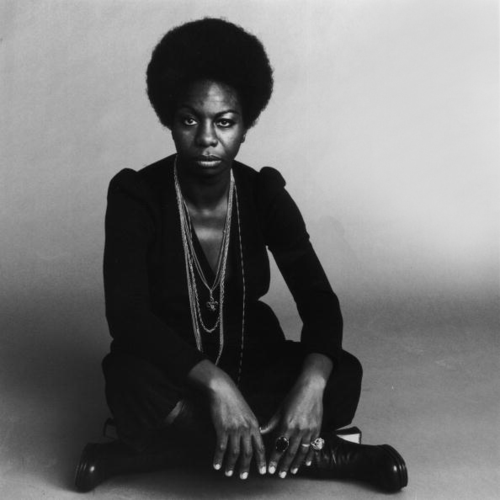
Nina Simone


Originally, Nina Simone wanted to be a classical pianist. In order to prepare for that, she applied to Curtis Institute of Music in Philadelphia, but she was turned down because she was Black. So she took a jazz gig at a club in Atlantic City to pay for her continued classical training, but the club wanted her to sing, too. So she did. And the rest is history.

Between 1958 and 1974, Simone recorded more than forty albums. Her style combined jazz, blues, gospel and classical licks with a throaty contralto that mesmerized her audiences all over the world. But this isn't why she made the cut as an in-your-face woman. That happened because of the lyrics to the songs she wrote and the messages her performances delivered, especially when the Civil Rights struggle heated up in the 1960's.

Simone's song "Old Jim Crow" talked about how laws were used to disparage and oppress Black folks in the U.S. South. She covered Billie Holiday's "Strange Fruit" (about lynching), recorded Billy Taylor's "I Wish I Knew How It Would Feel to be Free," and turned Lorraine Hansberry's "To Be Young, Gifted and Black" into a civil rights song.  Her response to the murder of NAACP organizer Medgar Evers -- "Mississippi Goddam!" -- was even boycotted in some states.

Two days before Simone's death in 2003, Curtis Institute of Music awarded her an honorary degree. Who knows what might have been different for this in-your-face woman -- and the world -- had they just admitted her all those years before. We'll never know. Perhaps that's for the best.

Thursday, August 30, 2012

Etta Shiber

Etta Shiber was a 62-year-old widow from Manhattan living with a woman friend of hers in Paris when she discovered -- as many women have -- that she had what it took to be an in-your-face woman. It was 1940. The Germans had occupied France. And British soldiers who had been separated from their units were hiding out in the woods by the hundreds.

Coming across one such soldier in a cafe, Shiber and her roommate immediately stashed the man in their trunk and started through the streets of Paris stopping at one Nazi checkpoint after another. And in almost no time, they had crafted an entire system to move young Englishmen through and back out of France -- usually several at a time.

The system lasted about six months before Shiber, her roommate, and a Catholic priest who was also part of their underground railroad were all arrested. Both of the others were sentenced to death, but the priest escaped. Shiber, on the other hand, being a U.S. citizen, was treated differently, especially since the United States hadn't entered the war, as yet.

Sentenced to three years in prison, Shiber -- quite ill and malnourished -- was traded for a German spy after a year and a half. Her memoir about the adventure is entitled Paris Underground, but Shiber never did understand why some folks saw what she did as heroic. "The Nazi invasion did it, not I," she explained casually to a reporter after she had recuperated. "I was looking forward to a quiet old age. I still am." Or was that said with a wink?

Wednesday, August 29, 2012

Evelyn Sharp


Evelyn Sharp was born into a respected English family in 1869. Despite receiving little formal education, she passed exams that demonstrated her intelligence and eventually was not only a popular children's book writer, but a successful journalist, as well. By the time she reached her mid-thirties, however, she was giving the lion's share of her attention to the struggle of women to gain the right to vote.

Initially, while actively writing, organizing and speaking as a suffragette, Sharp honored her mother's request that she not risk going to prison. But five years into her commitment, her mother wrote her a letter releasing her from her promise and within a matter of days, she had been arrested for breaking out the windows in a government building (see photo above).

Unlike some women fighting for the vote, Sharp was militantly against the First World War, as well, and refused to pay taxes, which resulted in all her property being confiscated. A subsequent action in support of political prisoners got her arrested and imprisoned yet again. But as Sharp once wrote: "Reforms can always wait a little longer, but freedom, directly you discover you haven't got it, will not wait another minute."

At sixty-three, she married her lover of more than three decades (during which time he was married to someone else and had multiple other lovers, as well) and published her autobiography entitled Unfinished Adventure. Women of today are often given to understand that women of yesterday were good little girls. Some were. And some weren't.

Tuesday, August 28, 2012

Hannah Shapiro

In September of 1910, Hannah Shapiro went to her supervisor at Hart, Shaffner and Marx in Chicago to complain about a pay cut. It wasn't just her pay that was being reduced. All the seamstresses had been hit. And it was only a loss of one quarter of a penny per pair of pants, after all. So what was the big deal? The supervisor said nothing could be done.

Shapiro, only seventeen at the time, thought it over and went back to her supervisor a few days later to press the point, but to no avail. So Shapiro and her co-workers from Shop #5 went on strike. Much to the surprise of their bosses, not only did the workers in other shops sewing for Hart, Shaffner and Marx refuse to take up the missing seamstress' slack, but in rapid succession, six more shops followed right behind Shapiro and Shop #5. And by only a few weeks later, 40,000 women garment workers -- many of whom were immigrants and most of whom were very young -- had walked out, refusing to return to work until their demands were satisfied (a period of several months).

Somehow, after the fact, Hannah Shapiro disappeared from the historical accounts of this first important strike that helped to lay the groundwork for much of the labor struggle that came afterward. Despite the fact that she collected money and walked the picket line day after day in bitter cold, her quiet nature kept her out of the limelight and out of the photos. So gradually, her role was forgotten.

Still, when an in-your-face woman takes action, others follow. And whether she gets the attention she deserves or not, it was her courage in walking out first that became the bridge the others used to cross the great divide to a better life. How many in-your-face women have changed the world through the ages and then disappeared into the woodwork as if they never lived?

Monday, August 27, 2012

Assata Shakur

After 500 years of hard core, unapologetic oppression by White people and a White Supremacist system, Black people in America were still, in the 1950's, experiencing the same brutality and exploitation they had suffered under for so long. Some Black folks made picket signs and held marches. Others, like Assata Shakur, attacked back. Born JoAnne Byron in 1947 in Queens, New York, by the mid-1960's, she was protesting with the other college students at Borough of Manhattan Community College, demanding more Black and African Studies courses and Black faculty. But it didn't stop there.

Disenchanted with the Black Panther Party because she felt that the men who were members often acted in macho ways and that, overall, Black and African history were not being prioritized in the way she felt they should be, Shakur moved on to the Black Liberation Army. In short order, however, she moved again, this time to the Republic of New Africa, an organization that was trying to establish a majority Black nation in the southern United States.

It's hard to know what Shakur did and did not do in these organizations. We know that she helped to organize the Black Panther Party breakfast program, for example. But by the early 1970's, she was on wanted posters all over the United States, charged with a whole gamut of criminal mayhem. Called by the authorities a "revolutionary mother hen" and "the soul of the Black Liberation Army," Shakur was accused by the FBI and other agencies of being connected to virtually every crime in North America for a while, but after she was arrested none of the accusations became formal charges. Between 1973 and 1977, she was charged and tried for murder, attempted murder, kidnapping, bank robbery and armed robbery, but she was acquitted or the charges were ultimately dismissed in every case.

Still, the Powers-That-Be were determined to see -- and keep -- Shakur in prison and eventually, they accomplished their objective. Beaten, held in solitary confinement, subjected to continual vaginal and anal searches, and ultimately winding up as the only woman prisoner in a facility for men, Shakur was named a "political prisoner" by U.S. activists. The United Nations Commission on Human Rights concluded in 1979 that her treatment was "totally unbefitting any prisoner" and her sentence promised to hold her in this position for another twenty years at least.

So, some of her comrades went in to visit her and -- using guns (though nobody was hurt) -- took her with them when they left. And in 1984, Assata Shakur left the country for Cuba where she has lived in exile ever since, still considered an escaped convict and a "domestic terrorist" by the U.S. government. Whatever some think of her personal politics, Shakur is most certainly an in-your-face woman as evidenced in her writing from Cuba: "Nobody in the world, nobody in history, has ever gotten their freedom by appealing to the moral sense of the people who were oppressing them...A woman's place is in the struggle."

Sunday, August 26, 2012

Huda Sha'arawi

Three years after Huda Sha'arawi was born into an upper class family in Minya, Egypt, in 1879, Great Britain invaded and occupied her country, but her life was circumscribed by ancient Egyptian rules for women. Women were expected to stay at home, even having their clothes delivered. Whenever a woman did leave the harem, they were required to cover their faces and hair. And though Sha'arawi was multi-lingual and well educated for a woman, she was married to a cousin at thirteen, as was typical. But that's where fate jumped in and changed her stars.

By whatever process of decision-making, the cousin chosen for Sha'arawi was not only a political activist, but a man who encouraged his wife to step out on her own as an individual in her own right. He supported her lecturing to and organizing women politically in their own best interests. He routinely sought her counsel and he even asked her to sit in on high level political meetings when he couldn't be present.

The result of all this was that, by World War I, Sha'arawi had established a women's welfare society to raise money for poor women, had helped to found a union for educated Egyptian women, and had opened a girls school that focused on academics instead of the things that women were usually allowed to learn. And, as soon as the war was over, in a particularly bold move, she started organizing women to protest the British occupation.

Then, in 1923, returning from a women's conference, Sha'arawi came down out of the train and shocked those who had come to meet her by simply removing her veil, instantly becoming -- quite literally -- the face of the Egyptian Feminist Union, a position she filled until her death at the age of sixty-eight. In one courageous act, Sha'arawi demonstrated her in-your-faced-ness by uncovering hers.

Saturday, August 25, 2012

Blanche Stuart Scott


Blanche Stuart Scott's parents knew they had an in-your-face woman on their hands when the automobile was invented and she was driving all over town before she was fifteen. So they sent her to finishing school in hopes that she'd come back a "lady." It didn't work.

In fact, rather than leaving the car alone, she decided, instead, to drive from New York City to San Francisco with a woman reporter as her passenger. The trip had already been made the year before by another in-your-face woman -- Alice Huyler Ramsey -- but when the Willys-Overland Company approached Scott about making the follow-up run, she didn't hesitate (a trait common to in-your-face women apparently). In any case, by the time she reached San Francisco in July of 1910, aviation pioneer Glenn Curtiss had offered her flying lessons and she was really off to the races.

In no time at all, Scott -- called "The Tomboy of the Air" -- was part of Curtiss' exhibition team, flying upside down and plummeting to the earth in "death dives," aerial nosedives that would begin at 4000 feet and only end when she pulled up the nose of the plane about 200 feet above the ground. Next, she flew sixty miles non-stop across New York in what was then a long distance flight. And followed that up by being a test pilot for Glenn Martin prototypes before the final blueprints were even drafted.

Eventually, though, Scott quit flying when it became apparent that women were not going to be allowed to be flight mechanics or engineers and the audiences became more obsessed by crashes than stunts. In-your-face women love showing off, but they're not stupid.

Friday, August 24, 2012

Pat Schroeder

It was no surprise to a lot of people that Pat Schroeder ran for public office. She had graduated from Harvard Law School. She had worked for Planned Parenthood and the Labor Relations Board. She was an in-your-face woman. So, at thirty-one, she was representing Colorado in the United States House of Representatives. And she sat right there for twenty-three years.

Unapologetically female and a mother, Schroeder took diapers with her onto the Congressional floor and distinguished herself by making bold statements and bold stands on behalf of women. The Military Family Act of 1985 and the Family and Medical Leave Act of 1993, for example, both owed their passing to her push. And she was always fighting the good old boys: undermining the power of committee chairs, questioning Congressional "hideaway" meetings, and challenging unethical traditional practices.

She's the one who called Reagan "the Teflon President." She's the one who talked about all the make-up President Nixon used to wear. And she's the one who told a bunch of Pentagon leaders -- when she was on the House Armed Services Committee -- that if they were women, they'd be pregnant all the time because they never said no.

Needless to say, they were all delighted when she wept in front of a microphone in 1987 as she announced her decision to abandon her run for the Presidency herself. Though, as a woman, she was never allowed to forget her show of emotion afterwards, she only dumped her file of men politicians crying in public when it got too big to keep. Her memoir, published in 1998, was entitled aptly enough 24 Years of Housework...and the Place is Still a Mess. Just imagine what laws might be passed if the female half of the U.S. population was actually represented by in-your-face women like Schroeder.

Thursday, August 23, 2012

Sophie Scholl

Much has been written about how difficult it was for Germans under the Nazi regime during World War II to resist government authority. Much has also been written about how that authority seemed to sneak up and grab a real strangle-hold on the mass public before they realized it had been done. But a small group of students, including one in-your-face woman saw what was happening, called it what it was, and did something about it.

Sophie Scholl, a biology and philosophy student at the University of Munich in the summer of 1942, had just turned twenty-one when she joined her brother and a scant few other of their friends in organizing a group they christened The White Rose Society after a novel that had been banned by the Nazis. Their primary action was to use a hand-cranked duplicating machine to print thousands each of six different leaflets against the Nazis and surreptitiously distribute them here and there in public spaces. Sophie was particularly good at it because soldiers weren't as suspicious of her as they might have been of one of the men.

Leaflet Three said in part: "Why do you allow these men who are in power to rob you step by step, openly and in secret, of one domain of your rights after another, until one day nothing, nothing at all will be left but a mechanised state system presided over by criminals and drunks? Is your spirit already so crushed by abuse that you forget it is your right – or rather, your moral duty to eliminate this system?"

Highly frustrated at this bold resistance right under their noses, the Nazi Powers-That-Be identified and arrested Sophie, her brother and one other man on February 18, 1943. They were tortured, tried, convicted and beheaded within three days. Speaking of Sophie Scholl, a prison guard said later, "She went without the flicker of an eyelash. None of us knew how this was possible. The executioner said he had never seen anyone meet [their] end as she did." Which only means they hadn't seen a lot of in-your-face women.

As she walked to the guillotine, Scholl was heard to say, "Such a fine, sunny day and I have to go, but what does my death matter if through us, thousands of people are awakened and stirred to action?" In 2003, proving that hundreds of thousands of Germans have been affected by Scholl's example, she and her brother were voted fourth on the list of the Top Ten Germans of All Time. Counting only the votes of those under forty, the two siblings were number one on the list. Not bad for one so young.

Wednesday, August 22, 2012

Odette Sansom

In-your-face women like Odette Sansom come out of the woodwork when a war's on. Sansom was French, but living in England with her three daughters when she accidentally sent some photos to the War Office and was invited to join the First Aid Nursing Yeomanry (FANY) under the Special Operations Executive. FANY operatives were the ones who went into France to work with the underground resistance network there. And Sansom didn't hesitate a minute to put her children in a convent school and get on about the business of saving France from the German occupiers.

Landing near Cannes in 1942 with information, instructions and plenty of money to help support the resistance, Sansom began work immediately, which was a good thing because, within a year, a double agent had betrayed her and she was arrested. Even though interrogators branded her and pulled out all her toenails at Fresnes Prison in Paris, Sansom stuck to her cover story which protected not only her, but her superior, who had also been arrested and was later to become her husband.

Sentenced to death and sent to Ravensbruck concentration camp, Sansom somehow survived the rest of the war and lived to be liberated so she could testify against her captors. Since a third of the women in the Special Operations Executive died or were executed in captivity, Sansom was the only one of them who was still alive when she received her George Cross (Britain's highest civilian honor for courage). In-your-face women hate to miss a party -- especially one thrown just for them.

Tuesday, August 21, 2012

Margaret Sanger

Margaret Sanger was the sixth of eleven children born to her devout Catholic mother who got pregnant eighteen times in twenty-two years before she died at only fifty years of age. It may be this graphic reality that inspired Sanger to say over and over later in her life: "No woman can call herself free that does not own and control her own body."

After becoming a nurse and working with poverty-stricken immigrant women on the East Side of Manhattan in New York City, Sanger was further disheartened by seeing the effects of multiple pregnancies and self-induced abortions that were common among her patients. So, in 1914, she began producing an eight-page monthly newsletter promoting contraception and other radical ideas. It was entitled, of course, The Woman Rebel and freely discussed what she called "birth control." As if this wasn't enough, Sanger and her husband also made available a booklet called Family Limitation, describing in clear detail various methods to prevent pregnancy.

At the time, federal anti-obscenity laws banned dissemination of such information, which Sanger perfectly well knew. And in truth, within a few months, she'd been charged with violating obscenity laws and "inciting murder and assassination." So she left the country. By the time she returned the following year, however, support for her and her work was so strong that the government ultimately had to drop the charges.

It doesn't take much to encourage an in-your-face woman to do what she wants to do anyway, so Sanger soon opened the first family planning and birth control clinic in the United States, where she began distributing, among other things, diaphragms imported from Denmark and widely used in Europe but not typically available in America. Nine days later, she was arrested again and this time she was tried and convicted, but she was offered a deal if she would just stop doing what she was doing. Her response: "I cannot respect the law as it exists today."

Even though the judge in that case ruled that "women do not have the right to copulate with the security that there will be no resulting conception" and sentenced Sanger to twenty days in jail, a subsequent appellate court eventually ruled that doctors could prescribe contraception. And in-your-face woman Margaret Sanger had beaten the big boys. In court.